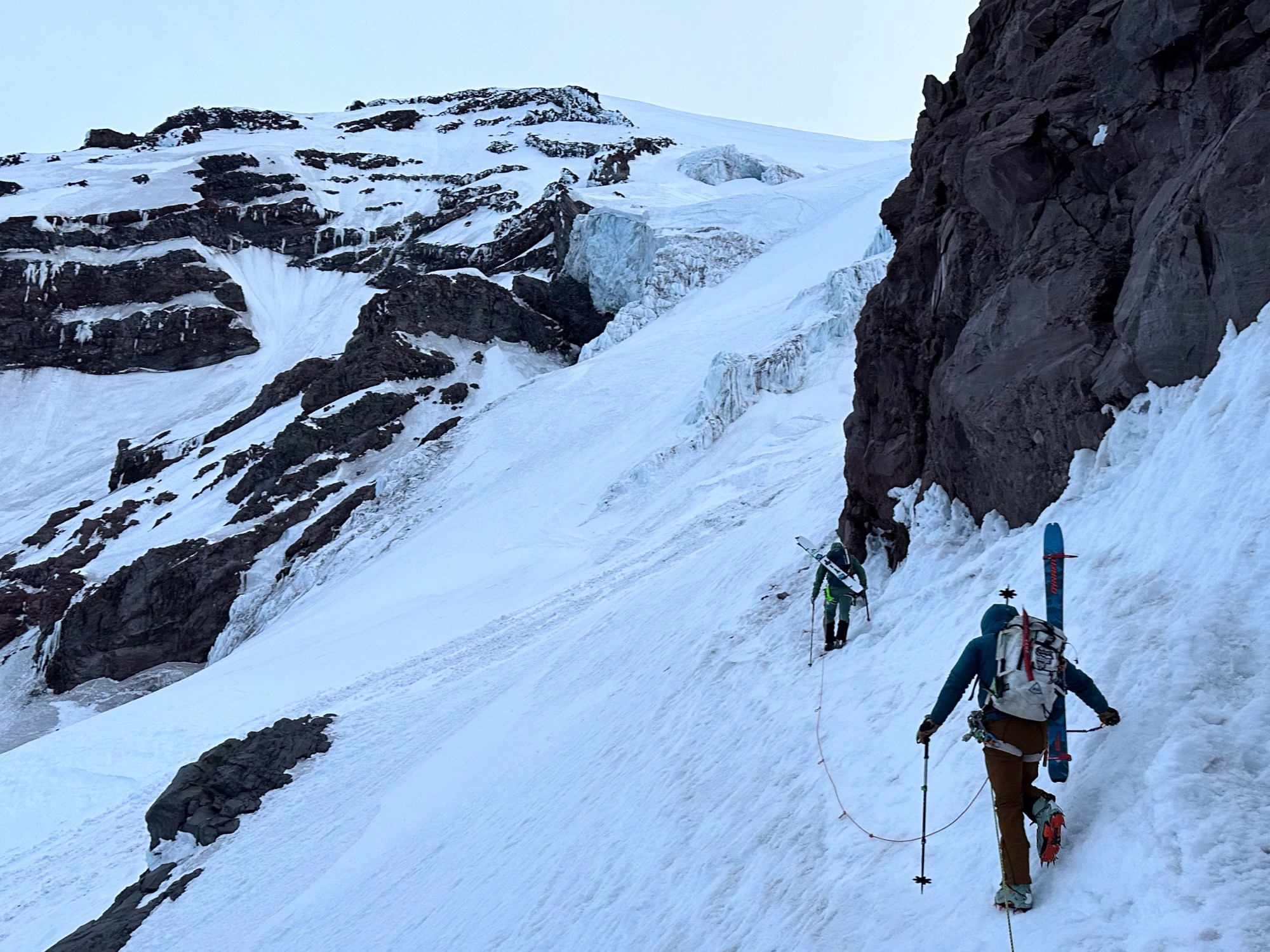
Cory Rekasie, Greg Rehn and I made a single push ascent and ski descent of Tahoma (Mt Rainier) via the Kautz Glacier on June 8-9, 2024 in about 17 hours roundtrip. What a day!
This trip came about in a serendipitous way, like all good climbs and stories. Cory and I go way back; he’s an expert skier and taught me most of what I know about sliding over snow in the backcountry. Last winter, Cory and I took a ski trip to Kootenay Pass. While we waited for the border crossing to open, Greg and his partner for the day pulled up behind us. We quickly decided to join forces and skied amazing powder right off the summit of Wolf Peak a few hours later. Greg and I hit it off quickly as we churned up the skin track, comparing our Denali stories and history of waterfall ice climbing. Months later, Greg and Cory had been planning a Rainier ski trip and I unexpectedly had a free weekend that coincided with their plan. When the invite came, I knew I couldn’t refuse.

It was 9pm on a June evening and I found myself at the foot of Rainier in a busy, paved parking lot. I felt off-kilter as I put skins on my skis for the first time in months and shouldered an alpine pack with two ice axes. My mind had been on warm rock climbs and cruising singletrack on my gravel bike rather than skiing and ice climbing. Despite the seasonal confusion, I was stoked to be setting off on a big adventure with friends. The mountain loomed above in the last bits of light for the day and it was time to set off. This climb would be Cory’s first time on Rainier. Greg had already reached the summit 16 times and made ski descents of 5 routes. My Rainier experience level is somewhere in the middle of the Greg-Cory spectrum. As we started skinning, I secretly was hoping that I’d be able to keep up with these guys and not slow them down too much!

A few hours into the day, I was finding my stride and we were making great time. We’d already crossed the Wilson Glacier and ascended the Fan, but I was feeling rather intimidated by this whole endeavor. I knew the terrain above would only get more serious and I was questioning if I had the skills on skis for this business. As we reached 8,000 feet, the snow had refrozen to the point that skinning on steep slopes above crevasses was losing its appeal. We took off our skis and I instantly felt more relaxed as I felt the reassuring bite of boot crampons into the snow. Travel on the frozen surface was quick and we dropped off the “rock step” at 11,200 feet right at first light. There was so much snow that we simply walked onto the glacier where most parties have to rappel due to steep, exposed rock.
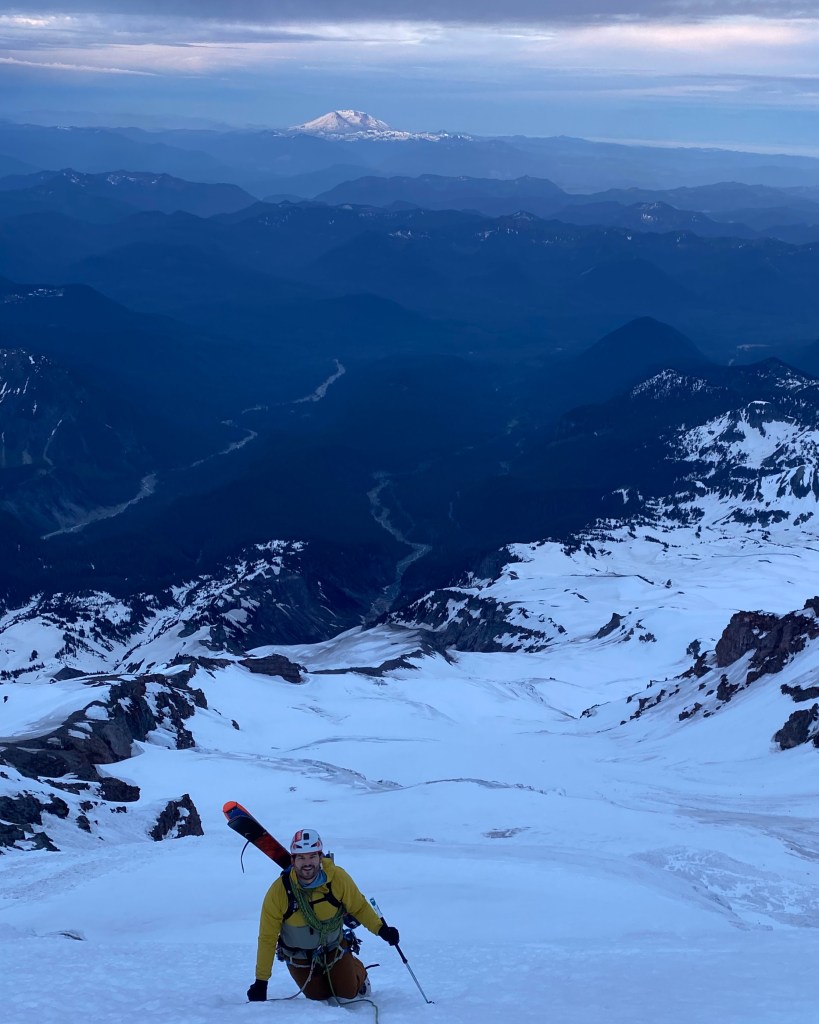
The Kautz ice chute was well-covered in snow which made for easy, secure climbing. There were some small patches of blue ice that we easily detoured around. Two ice axes were handy for this section, which we simulclimbed without protection. On the upper slopes of the Kautz, we kept charging hard despite the fatigue and altitude. As we staggered onto the summit crater rim, Cory admitted “I’m cracked!” – it’s a lot of work to get up there. At Greg’s insistence, we wrapped around the crater and reached the true summit in a whiteout almost exactly thirteen hours after we left the car. Greg has a strong belief that climbing to the true summit is the best possible style – it’s hard to argue with that.
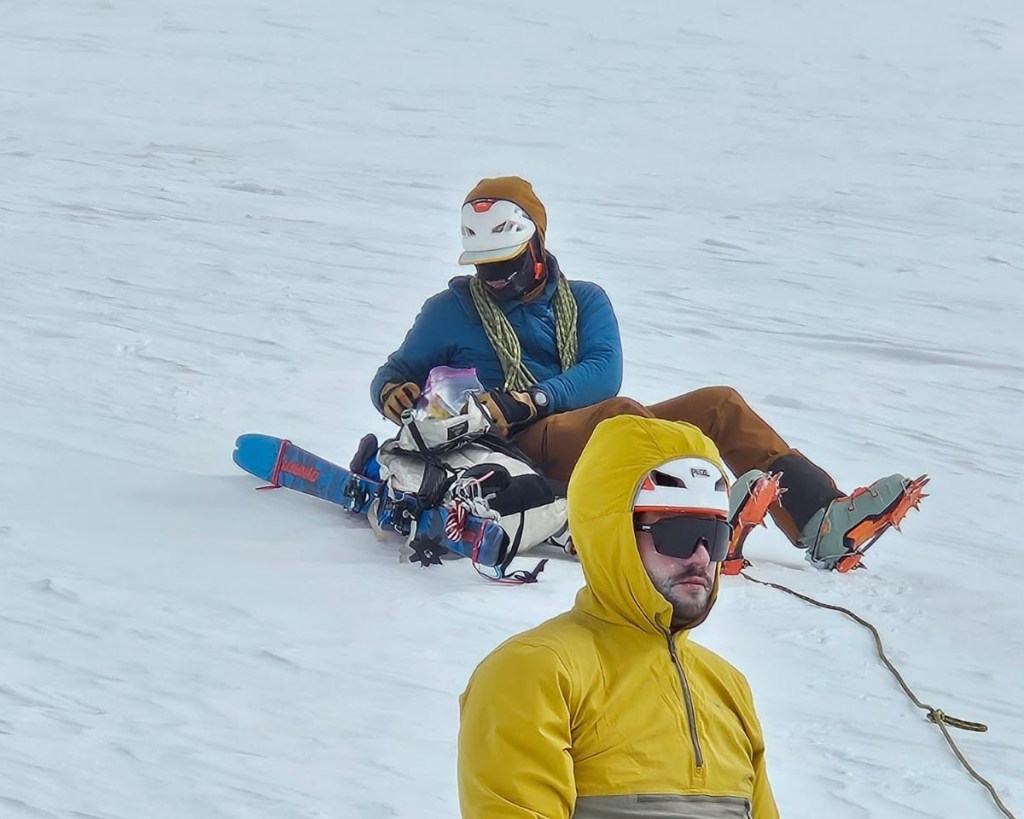
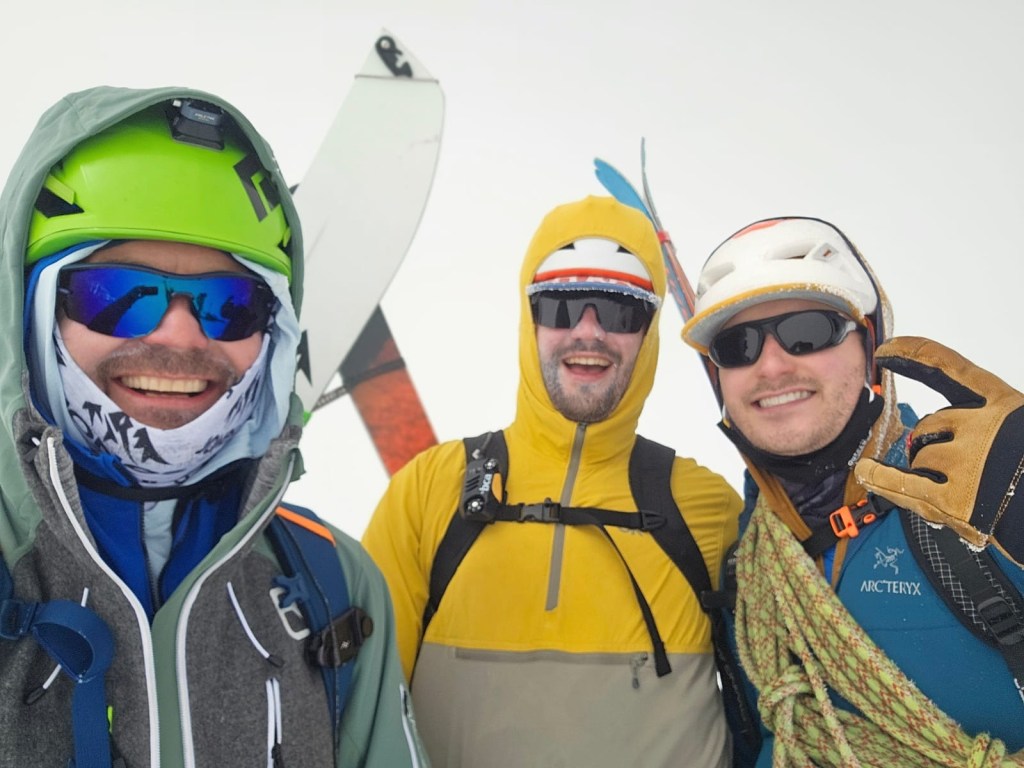
After reaching the summit, we dropped down into the crater to get out of the worst of the wind and take a break. A key part of ski mountaineering strategy is to time your descent correctly: start down too early, and the snow will be frozen and dangerous. Too late, and the snow will be too warm and heavy to make for good skiing. It’s impossible to nail conditions on the entirety of an almost-10,000 foot ski descent, but we wanted the upper mountain and especially the Kautz ice chute to soften up for us. After we found a good spot, we each put on all of the clothing we had and sat down to eat some food. Comically, we all completely fell asleep during this snack break. After an hour or so, Greg shivered himself awake and roused the team. We all had a laugh at how ridiculous it was to accidentally fall asleep on the summit of a massive, glaciated peak. I still had a half-eaten burrito in my hand when I opened my eyes! It was time to pack up and go skiing.

At the crater rim, I clicked into my skis and began making turns on frozen sastrugi. After perhaps 400 feet of descent, we broke out of the clouds into beautiful sunshine with unlimited visibility. The snow had softened into perfect “corn” and we were psyched! We carefully made our way down through crevasses, enjoying great snow conditions. There was some challenging routefinding to get back to the top of the Kautz ice chute that I hadn’t expected on the way up. Greg said that he’s never had such good snow conditions high on the mountain in his previous ski descents – we were having a day for all time. As I made perfect, creamy turns around 13,000 feet and took in the spectacular views of Mt St Helens, Adams and Hood, I realized that this may be one of the coolest days I’ll ever experience. Life is awesome!
Soon we arrived at the top of the ice chute, which is 60 degrees in steepness at the cruxes. A fall in this section would mean certain death – after cartwheeling down the ice chute, your final moments would involve shooting off a 300 foot ice cliff at high speed and landing on the lower glacier – yikes! I was not interested in experiencing that. I briefly considered transitioning to downclimbing with my ice axes and crampons, but I was already in such steep terrain that it seemed easier to just ski the damn thing. Time to go.
Cory went first, executing beautiful turns through the upper and lower cruxes which are split by some more mellow terrain. Greg went next on his splitboard, and I went last. I side slipped the upper crux, then made a handful of exciting turns in the central part of the chute. After side-slipping the lower crux, I removed my skis and walked back across the rock step. This was a huge moment – we still had 6000 feet of complicated terrain to ski down, but the most dangerous and technical terrain was behind us.


It was a crazy feeling to be skiing down the final section to Paradise. Casual hikers littered the trail and skiing through the crowds was really demanding on my destroyed thighs. With ice screws on my harness, an ice axe strapped to one ski pole, a foam helmet and goofy ski form, I was not surprised to see people taking photos as I slid past them to the parking lot.
Strategy Notes
Starting our climb at 9pm worked really nicely for us, but this is always a function of weather and conditions.
Gear Notes
Two ice axes/tools, steel crampons, skis.
 SPOKALPINE
this is gnarly
LikeLike