
There’s so many amazing climbs in the Cascades that an enterprising climber can have a respectable climbing career consisting of only the popular classics. In fact, climbing popular routes might be the best ratio of risk : reward : suffering. The lesser-traveled routes are usually not climbed often for a reason. Bad rock, dangerous pitches, and absurdly difficult approaches seem to keep the crowds at bay for perfectly understandable reasons – but sometimes there is gold hidden in these hills! For years, I have wanted to climb Argonaut Peak’s Northwest Arete, an aesthetic but largely ignored line on a sweet Stuart Range summit. This route is not mentioned in any guidebook (other than a couple of sentences in Cascade Alpine Guide) but there is some decent info online. The route follows a 45 degree snow gully to the crest of the Arete where five long pitches of rock climbing gain the summit. Marc didn’t hesitate for a moment when I suggested this objective, despite having never heard of the mountain! We climbed Argonaut’s NW Arete on June 19-20, 2026.

Marc and I did the typical bushwhack up Mountaineer’s Creek to the basin below Argonaut’s North aspect in about six hours. I was a little apprehensive about the water-polished slabs guarding the basin entrance due to online reports making them out to be a big deal, but we had no problem locating a mellow fourth-class route through. After strapping aluminum crampons on our approach shoes, we kicked our way up the snow. Where the slope steepens at the top, we trended right to gain the ridge crest at a more mellow spot given that we had lightweight shoes rather than sturdy boots which would have made the snow much more secure. There was a sweet bivy right where we topped out, but it was only 3pm on one of the longest days of the year. With six hours of daylight left, it didn’t make sense to stop here. Time to rock climb!


Starting to the right of the ridge crest, I set off on the first pitch on a steep gully feature. I felt a bit off-kilter climbing with a loaded overnight pack, but the climbing and protection were good. Marc took the next pitch to the base of a broad, steep wall. At first, it seems that there couldn’t be a moderate way through this wall, but a sneaky rising traverse all the way across the face revealed a line of holds on the right margin. I love this stuff: leading the pitch with a curious and determined mind, getting protection where you can and climbing well because you have to. There was one mantle in particular here that was engaging with the big pack on. A steep slab with cracks brought me to a large ledge for a belay.

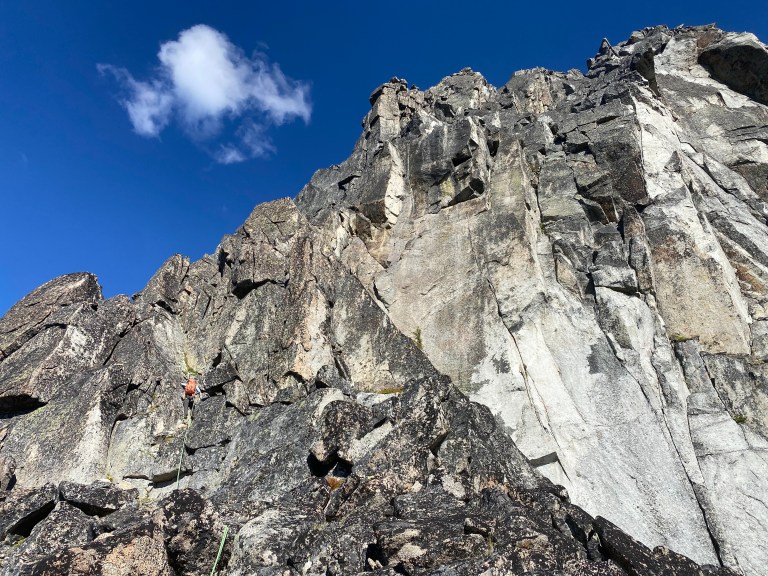
Marc took the reigns and led a super-fun right facing corner pitch. We swapped a few more leads on fun, juggy crack systems until we were right near the top. I made a routefinding mistake, following a steep gully all the way to the incredibly sharp crest of the East Ridge. It would be hard (and definitely scary) to gain the summit from there, so I downclimbed and tried again, this time heading left. I still didn’t manage to follow the best line and Marc led one final, 15 meter traverse pitch to a bivy site adjacent to the summit at 8pm. Perfect timing! Sunset views of Mt Stuart made it difficult to focus on making dinner and getting to bed.


By morning, the wind had kicked up considerably and I left the bivy wearing every piece of clothing I had. We tagged the summit about two minutes after leaving the bivy and began the somewhat complicated descent. Following the ridge crest on fourth class terrain brought us to a vantage overlooking the snow-covered Northeast Face. Rather than put on our crampons to cross the snow, we downclimbed steep rock next to the snow until we reached a melted-out ledge system. A traverse of the ledge and short fourth class climb back up to the ridge crest allowed us to avoid putting on crampons for the entire descent! A rappel from a notch in the East Ridge dropped us into the snow-filled Northeast Gully. Another rap allowed us to exit the gully onto the East Face. Two more raps down a gully from good anchors brought us back to the ground.

Rather than descend back into Mountaineer’s Creek for round two of bushwhacking, we traveled cross-country to Colchuck-Dragontail Col and the top of the Colchuck Glacier. This required a bit of elevation gain but the travel was mostly easy on granite slabs and snow. As we put on crampons at the top of the glacier, the first climbers of the day were arriving at the col. One particularly big personality lambasted us with backhanded compliments and subtle insults until we simply ran away down the glacier. With some people, it’s best to just get away and enjoy your day! A few hours of grinding down the moraine, then down Colchuck Lake trail, brought Marc and I back to the car, job done.


Marc and I had never climbed together prior to this trip so it was nice to hang out with a new friend in the alpine. This route has some loose rock but has some fun pitches. I’d recommend it to any Cascades choss aficionado, or anyone looking to climb Argonaut in an interesting way.
Gear Notes
Approach shoes, rock climbing shoes, aluminum crampons, ultralight ice axe, 70m twin rope (folded in half for climbing), offset nuts, cams .3-3 with doubles of .5 and .75. The doubles weren’t strictly necessary, but nice to have. The #3 is optional.
Strategy Notes
The two-day program is a nice way to climb Argonaut. Doing this line single push is physically very achievable but would probably require navigating Mountaineer’s Creek in the dark – this would be difficult and supremely annoying. The NW Arete is a legit route for a grade II.

